$399.99delivered

Boxed and listed as tested. Ask whether water dumps into the drip tray right after a shot, which shows the solenoid works.
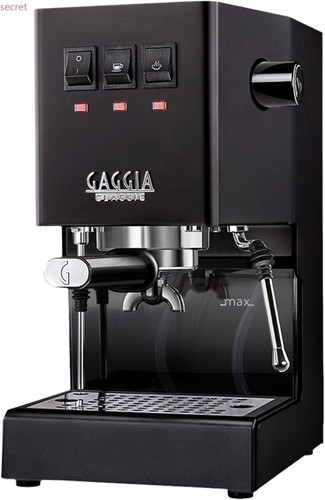
Gaggia Classic Pro RI9380/49 Espresso Machine Thunder Black w/Box Tested Italy
Gaggia has sold the Classic since 1991, and the 2019 Classic Pro put it back on form. It's a small 58mm single boiler with a huge modding scene behind it.

It's simple, built in Italy again, and retailers stock parts and upgrades for every version from 2019 on.
Skip any Classic that shows a Panarello wand or a Romanian label, because that's the 2015 version without the solenoid. Any 2019 Pro or later is fine, and the E24 with the brass boiler is the one to hunt for. Only a few complete Pros are listed, at $430–470 delivered, against $656 for the cheapest new one. That's about $200 saved by going used.
$399.99delivered
Boxed and listed as tested. Ask whether water dumps into the drip tray right after a shot, which shows the solenoid works.
Gaggia Classic Pro RI9380/49 Espresso Machine Thunder Black w/Box Tested Italy
$428.87est. delivered

An E24, the update with the bigger brass boiler, for $29 more than the cheapest Pro. It's the Classic to hunt for, and it's inside the band.
🔥RARE Gaggia Classic Coffee E24 Gold Espresso Machine Latte Art Lovers Italy
$399.99delivered
The seller says it's tested, so it should brew on arrival. Ask when it was last descaled, and descale it yourself if they can't say.
Gaggia Classic Pro RI9380/49 Espresso Machine Thunder Black w/Box Tested Italy
Delivered prices include shipping as eBay quoted it to a US address on Oct 19, 2026. Many sellers charge by distance, so your total may differ; eBay shows your exact total before you buy.
Captured . Some will have sold.
Delivered prices include shipping as eBay quoted it to a US address on Oct 19, 2026. Many sellers charge by distance, so your total may differ; eBay shows your exact total before you buy.
Used$399.99delivered
$399.99 · free shipping
Buy It Now$399.99
Good buy
Black Classic Pro with the box, listed as tested.
Seller: fewshfewsh
99.8% positive
Used$428.87est. delivered
$388.88 + $39.99 shipping
Buy It Now$388.88
Good buy
E24 in gold, the update with a brass boiler. The title's "RARE" is just a seller's word.
Seller: calalum87
100% positive
 For parts
$284.59est. delivered
$150.00 + $134.59 shipping
Buy It Now$150.00
This seller takes offers, and sellers often accept less than the asking price.
Fine if you might miss it? Send an offer first. Someone else can still buy it while you wait for a reply.
Want it for sure? Use Buy It Now.
Our take
Listed for parts with no fault named, and $135 of it is shipping. Ask what's wrong.
Seller: lanadw9
100% positive
 Used
$436.07est. delivered
$325.00 + $111.07 shipping
Buy It Now$325.00
This seller takes offers, and sellers often accept less than the asking price.
Fine if you might miss it? Send an offer first. Someone else can still buy it while you wait for a reply.
Want it for sure? Use Buy It Now.
Our take
Comes with portafilters. $111 of the $436 is shipping.
Seller: cbru1146
100% positive
 Used
$455.01est. delivered
$429.00 + $26.01 shipping
Buy It Now$429.00
Our take
Evo Pro, listed as working and lightly used.
Seller: strattonbrickyard
100% positive
 Used
$464.00delivered
$464.00 · free shipping
Buy It Now$464.00
Our take
Evo Pro in Thunder Black, free shipping.
Seller: secret-sky-new
99.7% positive
 New
$655.76delivered
$655.76 · free shipping
Buy It Now$655.76
Our take
New Evo Pro, the lowest new price here.
Seller: bookmarkdeals
99.8% positive
 Used
$450.00est. delivered
$400.00 + $50.00 shipping
Buy It Now$400.00
This seller takes offers, and sellers often accept less than the asking price.
Fine if you might miss it? Send an offer first. Someone else can still buy it while you wait for a reply.
Want it for sure? Use Buy It Now.
Heads-up: check the seller
E24, said to be updated and lightly used. Seller has no feedback yet.
Seller: maygenoito
No feedback yet
Prices and stock change daily. The live search shows everything listed now.
View all on eBay ↗Gaggia has sold the Classic since 1991, and the 2019 Classic Pro put it back on form. It's a small 58mm single boiler with a huge modding scene behind it.
A first espresso machine for someone who likes to tinker. Use it stock with a good grinder, or add a PID or a lower drip tray later.
Classics sold under this name fall into a few groups. There are Milan-built machines from before 2015, the 2015 Romanian-built redesign, the 2019 Classic Pro, the 2023 Evo Pro, and the E24 update with a brass boiler.
The 2015 redesign is the one to skip. It has no solenoid valve and came with a Panarello steam wand, and the 2019 Pro fixed both.
The boiler is small, so steaming takes longer than on a Silvia. In James Hoffmann's 2020 test the Classic Pro took 42 seconds to steam milk the Silvia did in 21.
A 9-bar OPV spring was the classic first mod on older Pros. North American Evo Pro and E24 machines come set to 9 bar from the factory.
Red means walk away. Yellow means budget for it. Green is a good sign.
Gaggia launched the Classic in 1991 with a stainless steel body and professional features, and it's been in production ever since. Saeco bought Gaggia in 1999 and Philips bought Saeco in 2009. Under Philips, Classic production moved to Romania, and the 2015 version dropped the solenoid valve and shipped with a Panarello wand. Fans complained. Philips sold Gaggia to N&W in 2017, and in 2019 the Italian-built Classic Pro arrived with the solenoid back, a proper steam wand and a smaller aluminum boiler. The 2023 Evo Pro added a stainless portafilter, a quieter pump mount and, in North America, a 9-bar OPV. The E24 then swapped in a brass boiler with more capacity. Any 2019 Pro or later is fine used, and if an E24 turns up, take it.
It's built from commercial-grade parts and is one of the best-documented home machines ever made, so even a tired one can usually be put right.
It's a well-made little machine, but 57mm parts only come from Lelit, so make sure the portafilter and baskets are included and the PID works.
Owners keep them going for years, but Breville tells you not to open it for service, so you're buying on how it runs today.
Links go straight to eBay and Amazon, with no tracking. We earn nothing from them.
Any Classic Pro from 2019 on. The E24 is the pick if you find one, since its brass boiler holds temperature better and has more capacity than the aluminum one. Skip the 2015 Romanian-built version unless you want a project.
No. The Classic takes 58mm baskets, but portafilters made for E61 machines won't lock into its group. Buy one sold for the Gaggia Classic.
No. The Classic UP is a newer model built on the E24's brass boiler and group, with a PID, a brew pressure gauge and an articulated steam wand. Neither it nor the dual boiler Classic GT shows up in the listings here.